
Running a small company across one border means every plan sits on two sets of rules. A tax change in one country, a weaker currency in the other or a slow-paying client abroad can squeeze your margins within a month, even when sales look steady.
Scenario planning for a small company operating in two countries comes down to a practical habit. You pick the few forces that hit your two markets differently, build a base case, a downside and an upside around them, and decide in advance what you will do when each one starts to show.
A spreadsheet, two working afternoons a year and honest numbers from both sides of the border will get you most of the way.
Key Takeaways
- Build three scenarios at most: a base case, a downside and an upside, each tied to real numbers.
- Focus on the drivers that differ between your two countries, such as tax, currency and payment timing.
- Run every scenario through cash flow first, because a profitable firm can still run dry in one market.
- Set clear trigger points so you know when to switch plans before a problem turns urgent.
- Check tax treaties and filing calendars, since timing gaps often hurt small firms more than tax rates do.
- Review your scenarios twice a year and after any major tax, legal or exchange rate change.
Why Two Countries Change the Way You Plan
The structure you choose at the start also decides which scenarios will matter later. A branch, a subsidiary and a contractor arrangement each react differently when profits rise or a rule changes. If one of your markets is Montenegro, a practical overview of business setup in Montenegro with VegaPlus shows how the legal form, tax number and VAT registration fit together before you start modelling outcomes.
Some risks barely exist for a purely domestic firm.
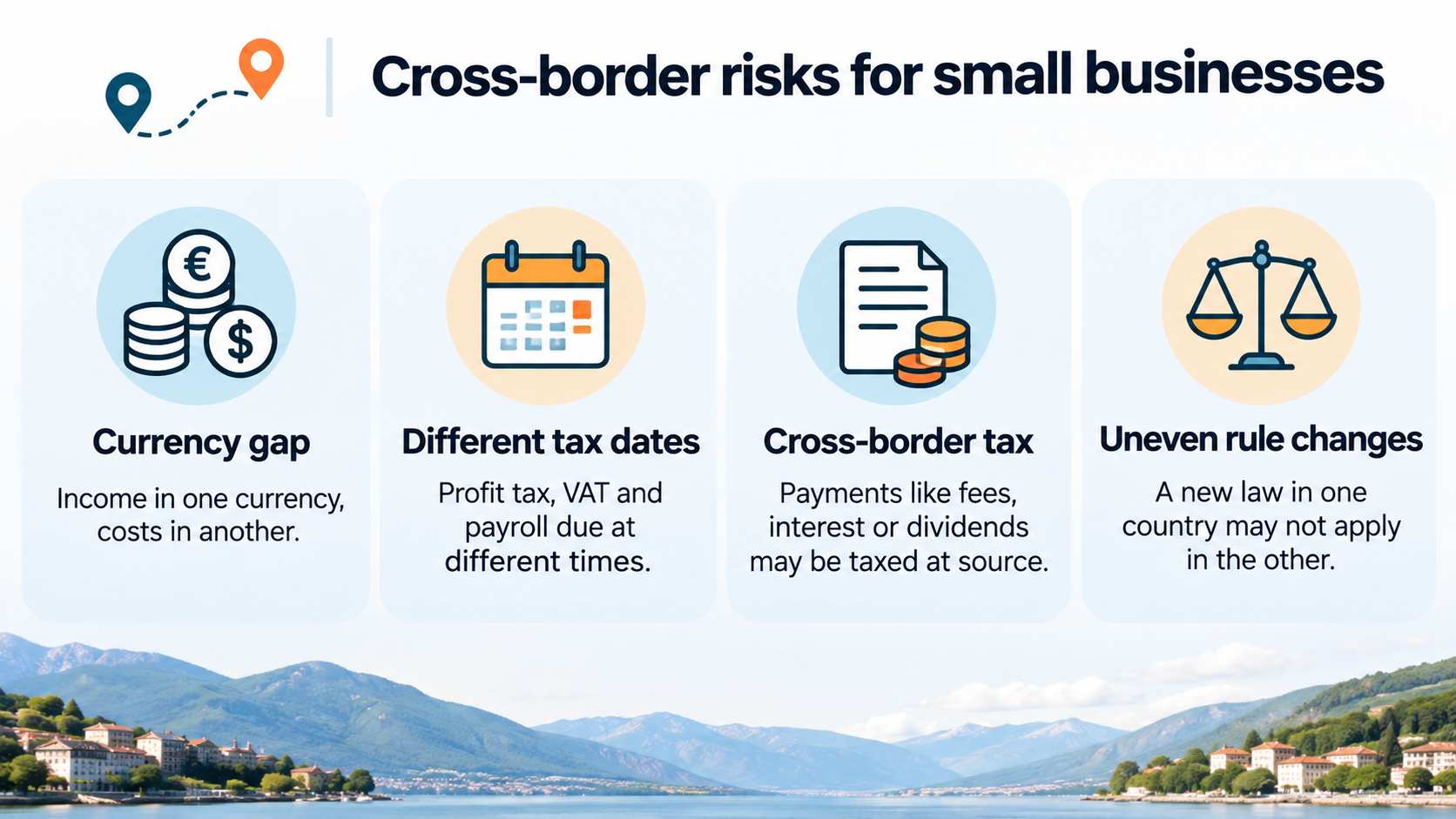
Once you operate in two places, they move to the top of the list:
- Currency mismatch: you earn in one currency and pay salaries or suppliers in another.
- Tax timing: profit tax, VAT and payroll deadlines fall on different dates.
- Withholding tax: fees, interest or dividends paid across the border may be taxed at source.
- One-sided rule changes: a new law in one country leaves the other untouched.
None of these needs to be dramatic to hurt a business with ten or fifteen people. Two of them landing in the same quarter can be enough to stall a hiring plan. That is exactly the kind of overlap a good scenario should expose.
How to Build Your Scenarios in Five Steps

The process below works for a firm with two locations and no dedicated finance team. Each step builds on the previous one, so resist the urge to jump straight to the numbers. The thinking in the first two steps keeps the spreadsheet honest later.
Step 1: List the drivers that differ between your countries
Write down every external force that could change your revenue or costs over the next 12 to 24 months. Then mark the ones that behave differently in each country, such as exchange rates, profit tax brackets, VAT and labour rules. Leave room for quieter costs as well, and use the guide on hidden compliance costs every small business should budget for as a checklist.
Step 2: Pick two big uncertainties and build three cases
From your list, choose the two drivers that are both highly uncertain and highly important. For many cross-border firms, those are the exchange rate and the health of the client base in the smaller market. Combine them into three believable cases and give each a short name your team can use in meetings.
Step 3: Run each case through cash flow
Profit tells you whether the business works, while cash tells you whether it survives the next quarter. Build a monthly cash view for each country and a combined view on top.
The walkthrough on how to create a simple financial forecast gives you a format you can copy for each market, and you should add both countries’ tax dates to the same sheet.
Step 4: Set triggers and agree on responses
Good triggers are specific and easy to check, such as an exchange rate move above a set percentage or a key client paying more than 45 days late. In Montenegro, bills and adopted acts appear on the Parliament of Montenegro website, which makes legal changes easy to track. For every trigger, write down the first two actions you will take.
Step 5: Review on a fixed rhythm
Put two review dates in the calendar, for example after the annual accounts and before budget season. Update the drivers, check whether any trigger has fired and adjust the cases. Once the template exists, a review rarely takes more than two hours.
A Worked Example: Montenegro and Serbia
Montenegro and Serbia make a good illustration because they share a language and deep trade ties yet run different money and tax systems. Trade in goods between them reached EUR 1.57 billion in 2025, and Serbia is Montenegro’s leading trade partner, according to Serbia’s Ministry of Foreign Affairs. Many small agencies, distributors and IT firms work on both sides of that border.
| Planning driver | Montenegro | Serbia |
| Currency | Euro | Serbian dinar (RSD) |
| Corporate profit tax | Progressive: 9%, 12% and 15% | Flat 15% |
| Standard VAT rate | 21%, reduced 7% and 15% | 20%, reduced 10% |
| Withholding tax on many outgoing payments | 15% | 20% standard, often lower under treaties |
| Bilateral tax treaty | In force | In force |
| EU membership path | Final stage of accession talks | Candidate, talks ongoing |
The Montenegrin brackets matter for an upside scenario. Profit up to €100,000 is taxed at 9%, the band up to €1,500,000 pays €9,000 plus 12% on the excess, and the top rate is 15%. Registration steps are covered in the official Montenegro tax portal guide to company formation, while Serbia keeps a flat 15% rate with no local add-ons.
Currency deserves a downside test even in calm times. The dinar’s official middle rate moved only between roughly 117.05 and 117.42 per euro across 2025, as N1 reported using central bank data. Double taxation is limited by the treaty signed in Belgrade on 20 July 2011 and applied from 2012, and you can read the text in Montenegro’s legal database.
Three scenarios for the example company
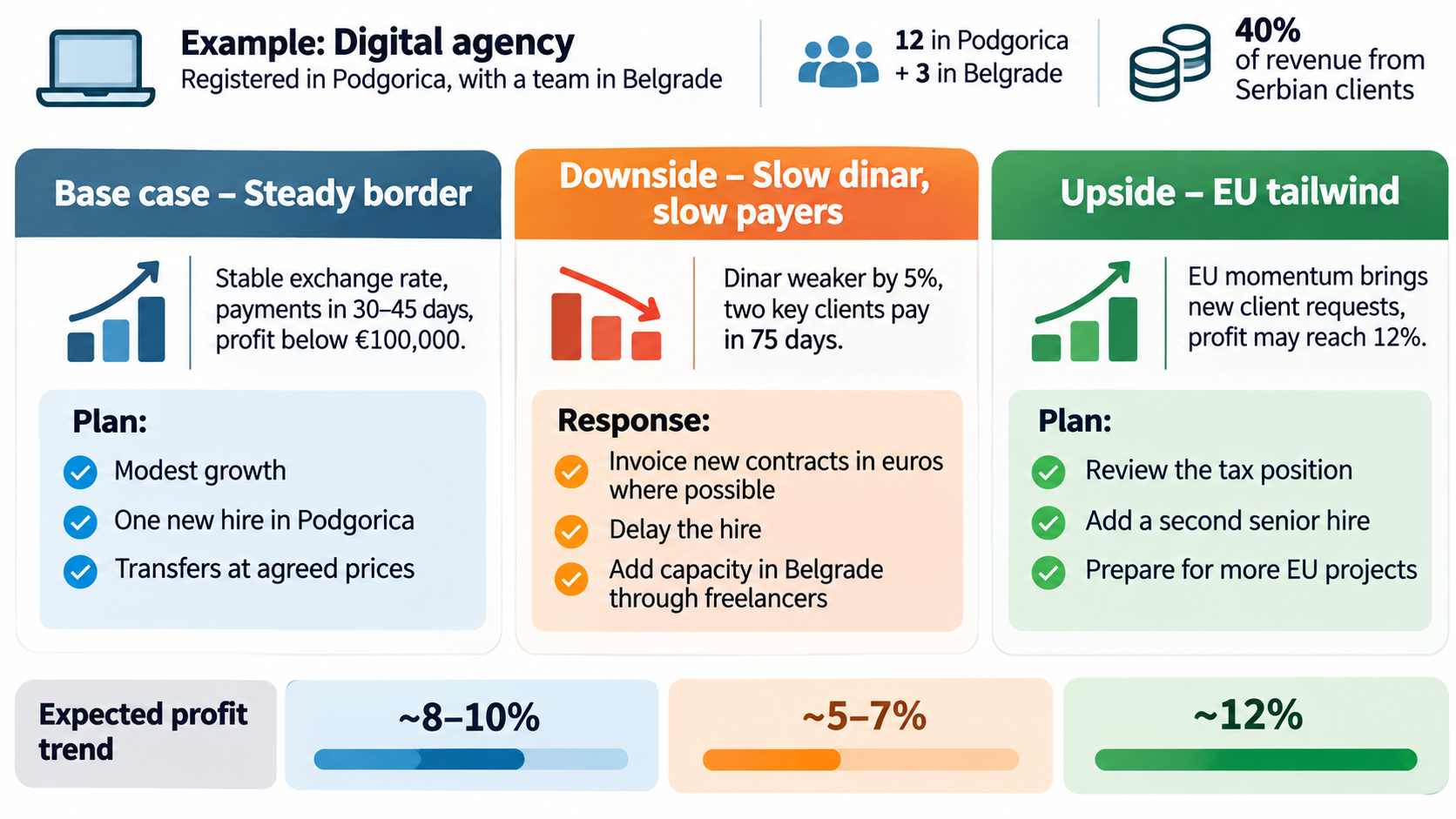
Take a 12-person digital agency registered in Podgorica, with a three-person team in Belgrade and about 40% of revenue from Serbian clients.
Base case: “Steady border.” The exchange rate stays in its recent range, Serbian clients pay in 30 to 45 days and Montenegrin profit stays under €100,000. The plan is modest growth and one new hire in Podgorica. Transfers between the entities follow agreed transfer prices.
Downside: “Slow dinar, slow payers.” The dinar weakens by 5% and two large Serbian clients stretch payments to 75 days. The agreed response is to invoice new contracts in euros where possible, delay the hire and add Belgrade capacity through freelancers, using the advice on how growing firms structure benefits for self-employed contractors to keep those arrangements stable.
Upside: “EU tailwind.” Montenegro has provisionally closed 21 negotiating chapters and is pushing to finish the rest, as European Western Balkans reported in October 2026. If EU clients start asking for quotes, profit may move into the 12% band. The plan then includes a tax review and a second senior hire.
Frequently Asked Questions
Final Thoughts
Scenario planning for a small company in two countries rewards owners who keep it simple. Pick the drivers that truly differ between your markets, turn them into three believable cases and test each against monthly cash. When one country surprises you, you will spend your energy acting instead of guessing.